
Links to B&H and other dealers in a story may earn T-Stop a commission at no cost to the reader. As an Amazon Associate, T-Stop earns from qualifying purchases.
SIGMA brings 16-300mm f/3.5-6.7 DC OS Contemporary to Nikon Z with Z-specific AF and weather seal
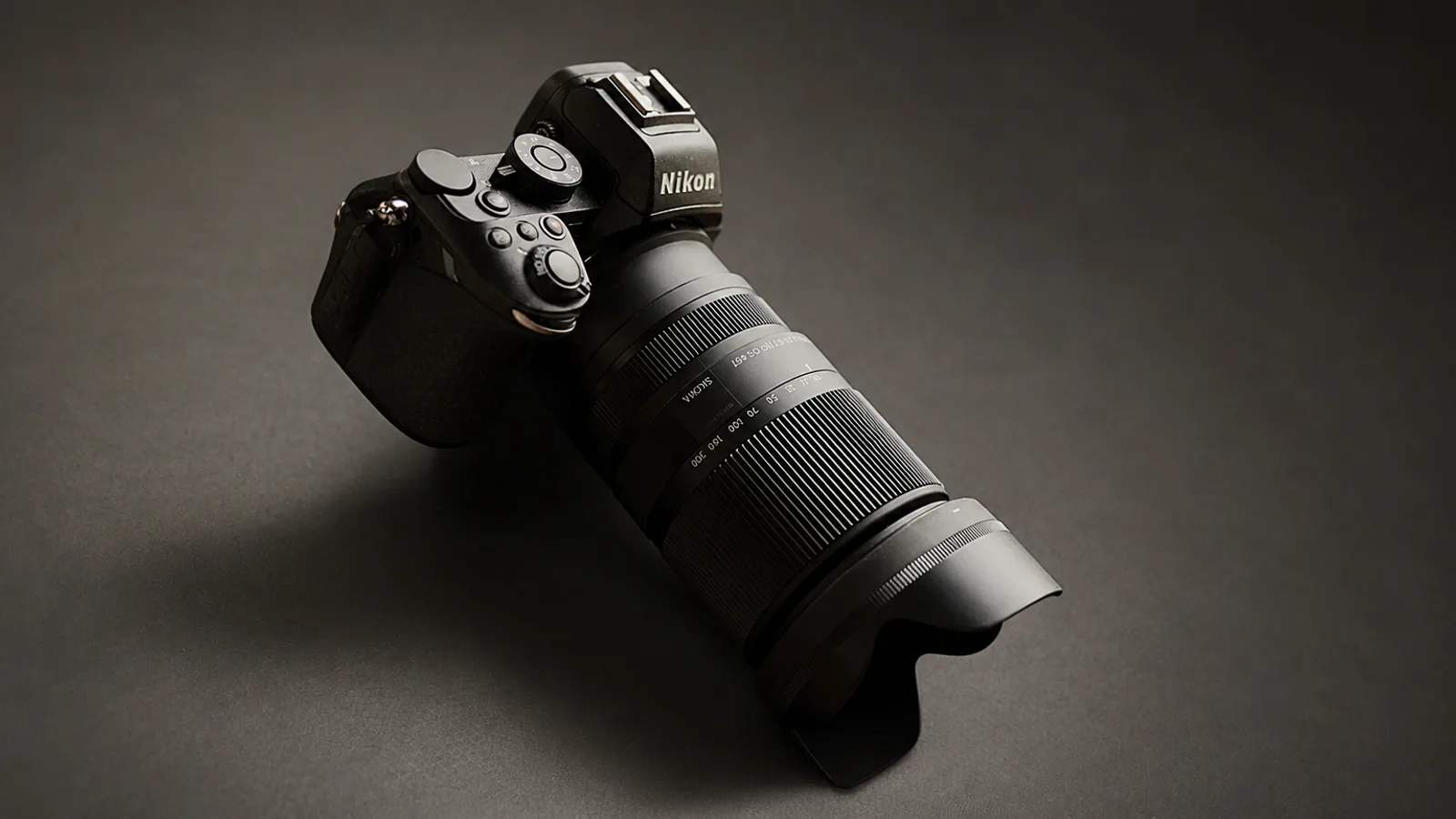
SIGMA has released a Nikon Z mount version of its 16-300mm f/3.5-6.7 DC OS Contemporary, adding a Z-tuned AF algorithm and a rubber-sealed mount.
Key points
- SIGMA has released the 16-300mm f/3.5-6.7 DC OS Contemporary for Nikon Z mount.
- The Z lens measures 73.8 x 125.4mm / 2.9 x 4.9in and weighs 630g / 22.2oz, longer and heavier than the L‑Mount version.
- SIGMA added a Z-specific AF control algorithm, a rubber-sealed mount and kept the same optics.
SIGMA has expanded its Contemporary line for mirrorless by adapting the 16-300mm f/3.5-6.7 DC OS Contemporary to Nikon Z mount. The move delivers an APS-C mirrorless all-in-one zoom option that SIGMA describes as a "stabilized 24-450mm equivalent all-in-one zoom," while the company says the optical formula itself has been carried over unchanged.
The Z-mount version is not merely a flange swap: SIGMA developed a control algorithm specifically for Z mount lenses that it says optimizes AF drive and lens-to-body communication. That software work is the headline change here — SIGMA notes that "the optics are unchanged, so the work went into the electronics." The Z model also gains a rubber-sealed mount for improved protection against the elements.
Physically the Nikon Z iteration is the longest and heaviest among the five mounts SIGMA offers for this model. It measures 73.8 x 125.4mm / 2.9 x 4.9in and weighs 630g / 22.2oz, compared with the L‑Mount lensʼ 121.4mm / 4.8in length and 615g / 21.7oz weight. The filter thread remains 67mm.
SIGMA kept the internal optical construction intact: the zoom contains 20 elements in 14 groups, with one FLD, four SLD and four aspherical elements. The diaphragm uses nine rounded blades. The minimum aperture ranges from f/22 at the wide end to f/45 at the long end.
On Nikon APS-C bodies that use the 1.5x crop factor, the lens covers an angle of view from 83.2° to 5.4°, which SIGMA equates to roughly 24-450mm in full-frame terms. SIGMA also highlights the lensʼ long zoom ratio, calling the 18.8x range "a world first for an autofocus lens made for mirrorless cameras," based on the company's own research as of September 2026.
Close-focusing performance is strong for an all-in-one. Minimum focusing distance is 17cm / 6.7in at the 16mm end and 105cm / 41.4in at 300mm. Maximum reproduction reaches 1:2 at 70mm; SIGMA's product page also lists 1:3 at the wide end and 1:4 at the telephoto end.
Autofocus is handled by SIGMA's HLA (High-response Linear Actuator) motor, which moves the focus group directly without gears and enables internal focusing. The lens carries a zoom lock switch to hold it at 16mm for transport, but the optical design does not employ a silent stepping focus method: zooming is not internal.
Stabilization for the lens uses SIGMA's OS2 algorithm. The company cites CIPA-style measurement figures of "rated at 6 stops at 16mm and 4.5 stops at 300mm." That is particularly relevant for Nikon's current APS-C Z cameras — the Z50II, Z fc and Z30 — which do not have in-body stabilization, meaning the lens delivers all of the motion compensation on those bodies.
SIGMA's Z-mount 16-300mm joins a small field of long-range APS-C zooms for Nikon Z. Nikon's own NIKKOR Z DX 18-140mm f/3.5-6.3 VR is much lighter at 315g / 11.1oz but starts at a 27mm equivalent and finishes at 210mm. Tamron's 18-300mm f/3.5-6.3 Di III-A VC VXD matches the 300mm long end and is marginally faster there at f/6.3, but also begins at a 27mm equivalent. SIGMA's lens is the only one of the three to open to a 24mm equivalent at the wide end.
Inside the barrel, SIGMA retained the same optical element roster and aperture hardware found in other mounts: 20 elements in 14 groups, nine rounded diaphragm blades and a minimum aperture that moves from f/22 to f/45 as you zoom toward the long end. Minimum focus distances and magnification figures are unchanged from the existing design.
SIGMA packages the lens with a soft pouch, the LH706-03 petal-type hood, and front and rear caps. The company also notes that a 50-120mm f/2.8 DC OS Contemporary model unveiled alongside the mount addition is not available for Z at launch.
Pricing and availability are part of the announcement: the Nikon Z version carries a U.S. asking price of $769 and a U.K. price of £599, and SIGMA says it will be "available from November 5, 2026."
For photographers weighing options, the trade-offs are clear. Buyers get a very broad focal-length range that reaches a 24mm-equivalent wide angle and a 450mm-equivalent telephoto on APS-C bodies, plus a substantial close-focus capability and a stabilization system tuned with SIGMA's OS2 firmware. That comes in a lens that is larger and heavier than SIGMA's own L‑Mount variant and significantly heavier than Nikon's light 18-140mm DX zoom.
SIGMA's choice to focus development on the drive and communication side rather than reworking the optics follows a broader industry pattern: adapting electronics to match a manufacturer's control protocols can unlock better AF performance and functionality without changing the lensʼ glass. For Nikon Z shooters who want a single-lens solution that reaches both wide and very long focal lengths, this update makes SIGMA's 16-300mm a direct contender, carrying the brand's established optical recipe into Z bodies and delivering built-in stabilization for bodies that lack it.
Owners of Z bodies should consider the size and weight increase when compared with lighter native DX zooms, and compare close-focus and magnification figures if macro-like capability matters. Otherwise, SIGMA has delivered the established 16-300mm optical package with Z-specific electronics and a weather-sealed mount, making the model ready to live on a Nikon APS-C camera's lens hood.
Technical specifications and performance claims in this story are taken from SIGMA's announcement and product information.
Specs
| Focal length (APS-C equivalent) | 24-450mm |
|---|---|
| Minimum aperture | f/22 to f/45 |
| Optical construction | 20 elements in 14 groups |
| Dimensions | 73.8 x 125.4mm / 2.9 x 4.9in |
| Weight | 630g / 22.2oz |
| Filter thread | 67mm |
| Minimum focus distance | 17cm / 6.7in (16mm); 105cm / 41.4in (300mm) |
| Maximum magnification | 1:2 at 70mm (1:3 wide; 1:4 tele) |
| Stabilizer | OS2; rated at 6 stops at 16mm and 4.5 stops at 300mm |
| In-box accessories | pouch, LH706-03 hood, front and rear caps |
| Price and availability | $769; £599; available from November 5, 2026. |
Where to buy
SIGMA 16-300mm f/3.5-6.7 DC OS ContemporaryFAQ
- Does the Nikon Z version use the same optics as other mounts?
- Yes. SIGMA says "the optics are unchanged, so the work went into the electronics."
- How much stabilization does the lens provide?
- SIGMA rates the lens' stabilizer at "6 stops at 16mm and 4.5 stops at 300mm."
- When will the Nikon Z 16-300mm be available and what is the price?
- SIGMA lists the Nikon Z mount 16-300mm at $769 (£599 in the UK) and says it will be "available from November 5, 2026."
Using or buying gear in the GCC? Read our GCC guide