
Links to B&H and other dealers in a story may earn T-Stop a commission at no cost to the reader. As an Amazon Associate, T-Stop earns from qualifying purchases.
Sony’s ECM‑W5 puts true 32‑bit float in the transmitter and records backups on each belt pack
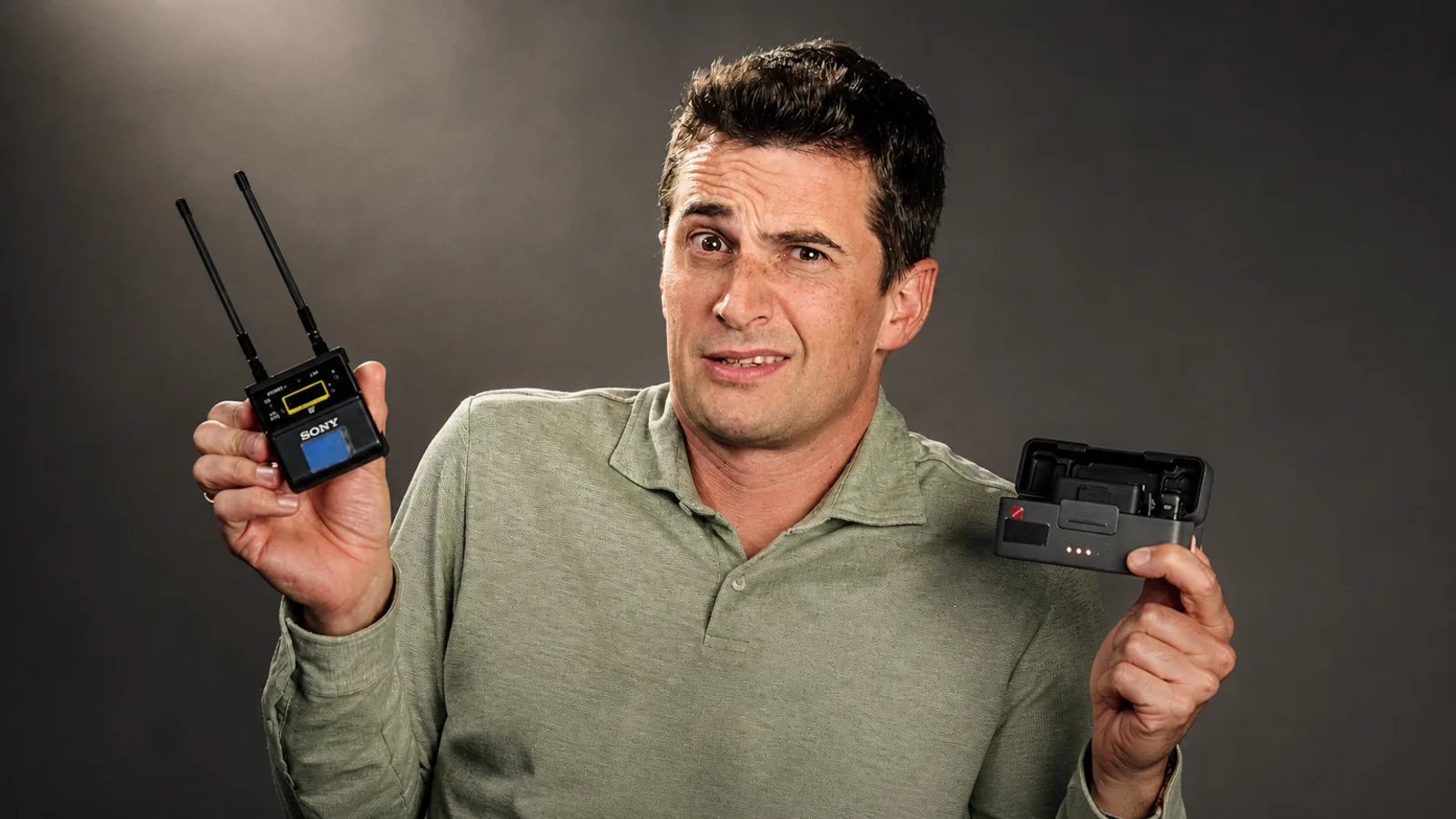
Sony’s new ECM‑W5 generates genuine 32‑bit float in its transmitter by stacking two 24‑bit converters, sends audio digitally over the Multi Interface Shoe, and stores backups on each transmitter.
Key points
- Sony's ECM-W5 generates real 32-bit float in the transmitter using two stacked 24-bit A/D converters.
- It sends audio digitally via the Multi Interface Shoe and provides up to four channels plus a 64 GB backup per transmitter.
- Experts say some kits were merely “upgraded” from 24-bit, and 2.4 GHz links can drop after 10–50 m without line of sight.
Sony’s ECM‑W5 takes a different technical route to the recent wave of 32‑bit‑float wireless offerings: instead of relying on in‑camera conversion or a single converter, the W5 produces a true 32‑bit‑float signal in the beltpack itself. Sony achieves that by stacking two 24‑bit A/D converters inside the transmitter and generating the 32‑bit float there, then sending the audio digitally into the camera through the Multi Interface Shoe.
That architecture has two practical effects that studios and run‑and‑gun crews will notice. First, the airborne signal coming into the camera is already in the wide‑dynamic‑range 32‑bit‑float format, so the camera records that representation rather than building it later from a 24‑bit source. Second, each transmitter carries local storage, allowing a copy to be kept on the beltpack as a fallback: Sony fits a 64 GB backup on every transmitter so you have a parallel recording independent of the radio link.
The kit supports multi‑channel use: Sony says the system handles up to four channels, which makes it suitable for small multicamera shoots, presentation booths, and interviews where more than one mic feed is needed. Those channels combined with onboard backup are clearly aimed at productions where losing a wireless feed is not an option.
The W5’s on‑transmitter conversion touches a broader debate in the audio world about what “32‑bit float” actually means in a wireless kit. Industry engineers have pointed out that there is no single 32‑bit analog‑to‑digital converter on the market, so producing a 32‑bit float typically requires combining multiple lower‑bit converters. Sony’s implementation follows that logic by using two stacked 24‑bit converters in the transmitter to achieve a real 32‑bit float representation.
Not every maker has taken the same path. Some manufacturers have delivered 32‑bit float claims through firmware changes to existing 24‑bit hardware, a move criticised by some experts as a superficial upgrade. Sony’s announcement highlights that distinction; one industry comment summed up the practice by pointing out some firms simply “upgraded” older 24‑bit systems by software rather than changing the signal chain.
There’s a caveat for anyone who prizes the recording format: editing workflows can defeat the advantages of 32‑bit float if they alter files after capture. If you adjust the level in post and then save that change, the resulting file may no longer retain the 32‑bit‑float characteristics it had at record time, so teams should think through how they manage and archive multitrack files to preserve the format when it matters.
Wireless performance and spectrum remain a crucial part of the story. The ECM‑W5 uses the camera shoe for the digital feed, but the radio layer still faces the same physics that affect any 2.4 GHz system. Shorter wavelengths at 2.4 GHz do not penetrate bodies, walls, or even the metal in some monitors as well as lower frequencies, and non‑line‑of‑sight links can fail quickly: designers and testers report link loss in the order of 10–50 m without direct sightlines.
That practical behaviour shapes how many devices you can run in a single room. Experience and engineering guidance put the realistic limit for independent 2.4 GHz wireless sets at about two or three per room before interference and drops become a real problem, whereas UHF systems can provide many more channels in a confined space—around 100 channels in well‑managed UHF installations at large events.
Latency is another differentiator. Commodity 2.4 GHz audio systems typically sit around 40 ms of latency, roughly two frames of delay at standard video frame rates, which can be noticeable in certain production setups. By contrast, low‑latency UHF systems have historically been much quicker: Sony’s DWX family, for example, began at 3.5 ms and more recent generations are down to 1.1 ms.
Spectrum pressures add a longer‑term consideration. Reallocations since 2012 moved the 800 MHz and then the 700 MHz bands into mobile services, leaving wireless microphone users with less contiguous UHF space as channel counts climb. For buyers and planners, the recommended UHF window to consider is 470–694 MHz, a range that industry voices expect to remain usable until 2031.
For users, the ECM‑W5’s approach will be attractive when true 32‑bit float, on‑belt backups and a camera‑shoe digital feed are priorities. As with any wireless audio choice, teams must balance format advantages against radio environment, channel planning, latency needs and post‑production practice.
Sony’s ECM‑W5 arrives into a market where the promise of 32‑bit float is reshaping expectations about headroom and gain‑management, but the effectiveness of that promise still depends on how manufacturers implement the conversion, how crews manage wireless density, and how editors treat captured files.
Specs
| A/D converters | two stacked 24-bit |
|---|---|
| Recorded format | 32-bit float (generated in transmitter) |
| Backup storage per transmitter | 64 GB |
| 2.4 GHz non‑line‑of‑sight drop distance | 10–50 m |
| Typical 2.4 GHz latency | around 40 ms |
| Sony DWX latency history | 3.5 ms → 1.1 ms (Gen 4) |
| Recommended UHF range | 470–694 MHz (usable until 2031) |
Where to buy
Sony ECM-W5FAQ
- Does the ECM‑W5 actually record 32‑bit float?
- Sony’s ECM‑W5 generates real 32‑bit float in the transmitter by using two stacked 24‑bit A/D converters and sends the format digitally over the Multi Interface Shoe.
- Can I rely on the transmitter backup if the wireless link fails?
- Each transmitter holds a 64 GB backup so you keep a separate recording on the beltpack alongside the camera feed.
- Are 2.4 GHz wireless links reliable in crowded spaces?
- 2.4 GHz signals can fail when not line of sight and may drop after 10–50 m; practical use is often limited to two or three systems per room, while well‑managed UHF can support many more channels.
Using or buying gear in the GCC? Read our GCC guide